Work
Selected work
Software and systems I have built or led, in research and in industry. Each entry says what was developed, what my part in it was, and where the work can be examined.
Open-source framework
Since 2010 · Initiator, co-lead
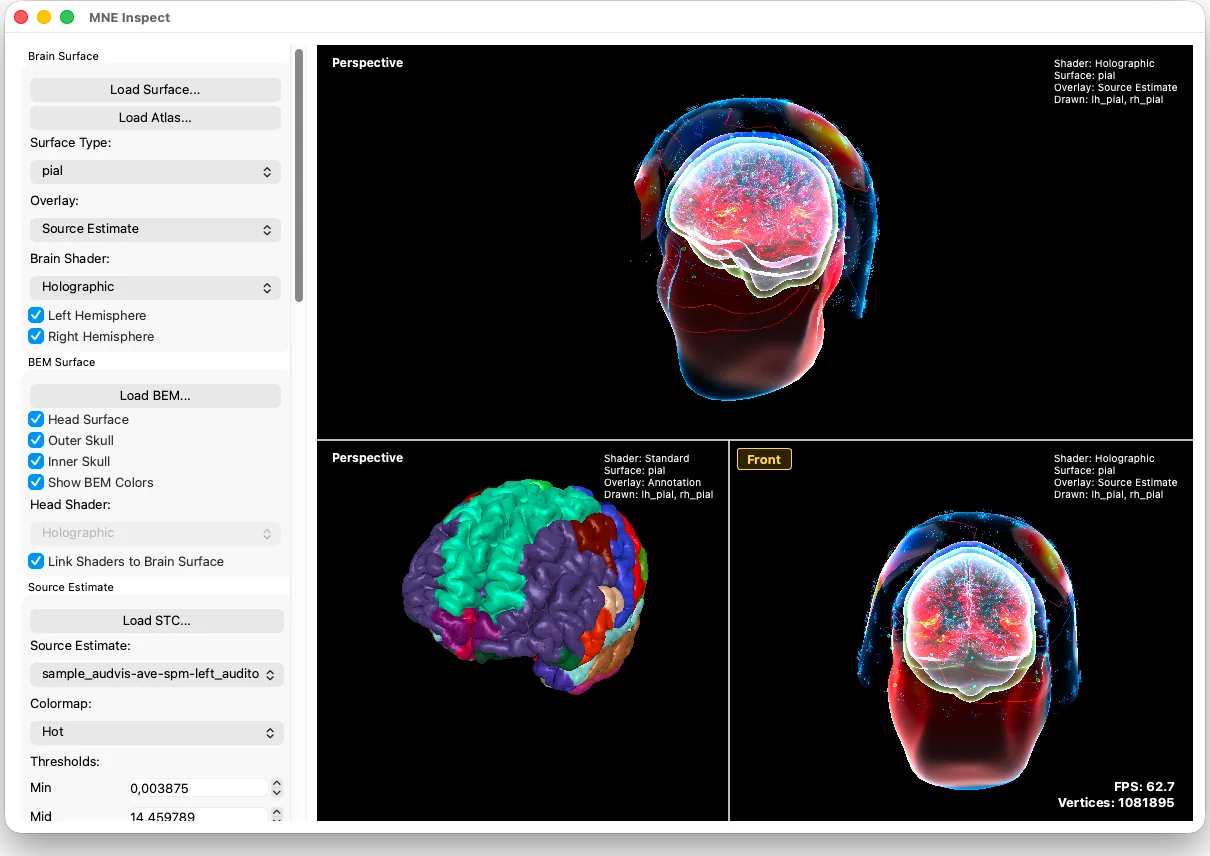
MNE-CPP
An open-source C++ framework for real-time and offline processing of MEG, EEG and related electrophysiological data. It provides the MNE methods as libraries with few dependencies, and applications for acquisition, analysis and visualisation built on them. It is collaborative research software: more than forty people have contributed.
ProjectRepository (opens in a new tab)Documentation (opens in a new tab)
Projects
2017–2025
MRI systems and ScanHub
Software lead, co-founder
Acquisition software for magnetic resonance imaging: MR#, a language for pulse sequences; a digital receiver implemented on a graphics card; and ScanHub, an open-source platform for scanner control, acquisition and processing.
Since 2026
The BCI Briefing
Publisher
An independent editorial project that follows research, clinical studies, technology and companies in brain–computer interfaces. Every claim carries its source and the kind of evidence behind it.
Research software
2019–today
CMNE (opens in a new tab)
Reference implementation of contextual minimum-norm estimates: a recurrent network that brings temporal context into MEG and EEG source estimates. Python, with model export for real-time use.
Since 2026
Skigen (opens in a new tab)
A header-only C++ library of machine-learning algorithms built on Eigen, with an interface modelled on scikit-learn. MNE-CPP uses it for its decoding and statistics routines.
2012–2017
HPCLib (opens in a new tab)
CUDA implementation of the RAP-MUSIC source-localisation scan from my doctoral work. Kept for reference; no longer developed.
In industry
Since 2015 my main employment has been in medical technology. The work below belongs to the companies concerned; I describe my role and what is public, and nothing beyond that.
Since 2022
ZEISS
Head of Physical AI & Computing (since 2026); previously team lead and software architect
At Carl Zeiss Meditec in Munich I worked on the architecture of platforms for machine learning and research data in regulated medical products. At the ZEISS Innovation Hub @ KIT I built a team for medical robotics and assistance systems, and I coordinate the company’s technology field of brain–computer interfaces. The content of this work is not public.
2021–2022
Ablacon
Research lead
Led a research team of seven working on signal processing and cloud-based analysis for electrographic flow mapping, which estimates the flow of electrical activation in the atria from catheter recordings in patients with atrial fibrillation.
2017–2021
Neoscan Solutions
Director of software development
Built the software team, from one engineer to seven, and the software of a magnetic resonance system for newborns: console, real-time acquisition and reconstruction. The sequence language MR# came out of this work.
2015–2016
Stryker
Software architect
Software architecture of ADAPT for Gamma3, an X-ray-based navigation system that assists implant placement in hip-fracture surgery. The system was developed under IEC 62304, in close contact with surgeons.